" Whatever may occur, do what you conceive to be your duty. "
The characters we meet in the story under analysis are only two main protagonists, that make the story vivid and precise. Theese are young soldier - Carter Druse and a Horseman, his father - a powerful and strong image of warrior. Each of them belongs to seperate parties which have devided american citizens on those who were under Federate party and others which were under Confederate party.
Carter Druse, the hero of the novel is a normal peasant, was born in Virginia. He loved his parents and home, but most of all he loved his country from his deep heart. As a southerner, he decided to join the Union Army of the North. Being for the Army of South, his father had nothing against his son, he respected his choise. Carter Druse is shown as brave, controversial, coward- but above all-patriotic. He isa person, who is able to kill a family member in order to receive peace and victory. He is hesitating, thinking over all the pluses and minuses of the situation. Of course he loved his father, but the love to American peace is closer to him.
The author reveals Carter Druse by means of narrative description with implied judgement. Actually he left the reader to make own judgement- what is better, pushes the reader to put himself on the place of the main hero. From both fact and judgement we derive impression of the main character as strong, responsible and hesitating man who finally makes the powerful decision, which may further change his mind and life. When the author informs us that Carter has killed not his farther, but a horse, which was driven by him,and they both have fallen down the cliff we come to share his respect and love to his father, for Carter's action and attitude; it was not just a cold case murder. The following comment of the narrator clearly indicates that Carter is full of emotions and dual feelings, but his duty for him is on the first place:
"The man's face was white, but he showed no other sign of emotion. Having answered, he turned away his eyes and said no more".Details of physical appearance are nearly absent.
Details of character:
"By conscience and courage, by deeds of devotion and daring, he soon commended himself to his fellows and his officers; and it was to these qualities and to some knowledge of the country that he owed his selection for his present perilous duty at the extreme outpost".Character's actions:
"the officer was overcome by the intensity of his emotions; his legs failed him and he fell."Character's speech: "Father, a Union regiment has arrived at Grafton. I am going to join it." (very confidently)
"The officer rose to his feet, trembling." "Peace, be still. He fired."
Officer was a wise man; he knew better than to tell an incredible truth. He said nothing of what he had seen. But when the commander asked him if in his scout he had learned anything of advantage to the expedition he answered: /
"Yes, sir; there is no road leading down into this valley from the southward."
Character's consiousness: " Is it then so terrible to kill an enemy in war--an enemy who has surprised a secret vital to the safety of one's self and comrades--an enemy more formidable for his knowledge than all his army for its numbers? Carter Druse grew pale; he shook in every limb, turned faint, and saw the statuesque group before him as black figures, rising, falling, moving unsteadily in arcs of circles in a fiery sky. His hand fell away from his weapon, his head slowly dropped until his face rested on the leaves in which he lay. This courageous gentleman and hardy soldier was near swooning from intensity of emotion."
The other character - better to say - problematic image of the story - is a Horseman. As a reader may understand he is the father of Carter. "The father lifted his leonine head, looked at the son a moment in silence, and replied: "Well, go, sir, and whatever may occur do what you conceive to be your duty." "Leonine" - an epithet, which already shows us his grace. But he also asks his son not to bother with this problem his ill mother.
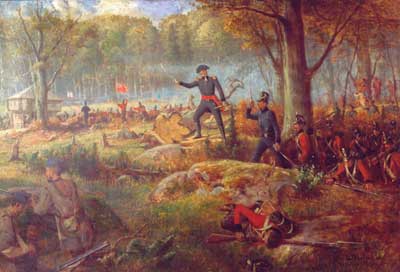 Then we see him in a role of horseman: "was an equestrian statue of impressive dignity. The figure of the man sat the figure of the horse, straight and soldierly, but with the repose of a Grecian god carved in the marble which limits the suggestion of activity."
 We may imagine his dress details: "The gray costume harmonized with its arial background; the metal of accoutrement and caparison was softened and subdued by the shadow"
Then, after Carter fired, there we can observe a ghost image, which can see Carter: "Lifting his eyes to the dizzy altitude of its summit the officer saw an astonishing sight--a man on horseback riding down into the valley through the air! Straight upright sat the rider, in military fashion, with a firm seat in the saddle, a strong clutch upon the rein to hold his charger from too impetuous a plunge."
Personally, I would say thad this is very hard decision. For me it is not a dilemma, I wouldn't kill anyone of my relatives in any case. I think the only reason that justifies Carter is a huge sence of patriotism; he is a man worth admiring and sympathy just for that. The words of the father have strongly set in the head of a soldier, but the power of patriotism sometimes, takes everything. I like how the author shows the characters - Carter is confident and brave, but at the same time hesitative, young and unexperienced soldier, who is going to be an outstanding american warrior. The Father Figure is shown perfectly, the reader can imagine a proud, calm and wise personality. This story is small, but still it gives no free space to continue it, there are no detalized description of main heroes' characters but the atmoshere captures the reader and holds him to the end.

Этот комментарий был удален автором.
ОтветитьУдалитьplease
Удалить