суббота, 30 ноября 2013 г.

#4 The setting of a story

The events in the analyzed story " The Horseman in the Sky" happen in the autumn of the year 1861. That was a year when a Civil War in America began. 
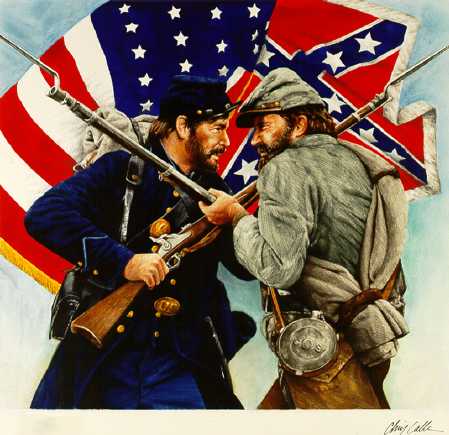
Though the story is devided into 4 parts, there we can find only one main setting. The soldier, as a main hero, Carter Druse was laying in a clump of laurel by the side of a road in western Virginia. The author gives a rather volumous description of that place:
"The clump of laurel in which the criminal lay was in the angle of a road which after ascending southward a steep acclivity to that point turned sharply to the west, running along the summit for perhaps one hundred yards. There it turned southward again and went zigzagging downward through the forest. At the salient of that second angle was a large flat rock, jutting out northward, overlooking the deep valley from which the road ascended. The rock capped a high cliff; a stone dropped from its outer edge would have fallen sheer downward one thousand feet to the tops of the pines. The angle where the soldier lay was on another spur of the same cliff. Had he been awake he would have commanded a view, not only of the short arm of the road and the jutting rock, but of the entire profile of the cliff below it. "
So, we know the exact location of the scene, we may imagine the whole picture in the way soldier can see it at that moment.
Oops, I've almost forgot to mention that from the point of view of presentation the story is the 3d person narrative. You know, a reader will 100% say that the author has also participated in the war. The setting described in very detailed way indeed.
Bierce describes a wonderful nature around that place:
"The country was wooded everywhere except at the bottom of the valley to the northward, where there was a small natural meadow, through which flowed a stream scarcely visible from the valley's rim. This open ground looked hardly larger than an ordinary door-yard, but was really several acres in extent. Its green was more vivid than that of the inclosing forest.."
But then, he stresses on the inervention of the man to this peaceful and beautiful place:

 "No country is so wild and difficult but men will make it a theatre of war; concealed in the forest at the bottom of that military rat-trap, in which half a hundred men in possession of the exits might have starved an army to submission, lay five regiments of Federal infantry" 

After the 1st chapter, the author gives some information about the main character. He tells his father his decision. This also gives us an opportunity to imagine the scene. But then he returns to the present and to the main situational setting.

So, after analysing some plot details I came to the conclusion, that the setting of the events is historical. It is presented in the most detailed way. It provides a historical and cultural context that contributes to our understanding of the characters. Somehow it is also symbolizing the emotional state of the character.

#3 Author: Life, literary style, publications.

Now, let me introduce the author of my chosen novel. This page comprises information about his individual style, cultural and histotical background and other famous works.         

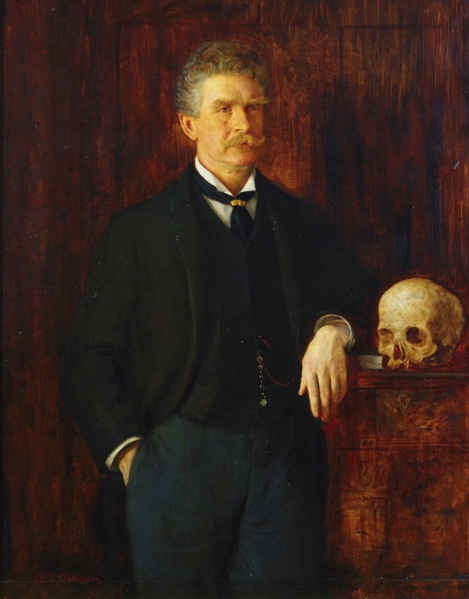
Ambrose Bierce

1842–1914
Ambrose Bierce
Ambrose Bierce's literary reputation is based primarily on his short stories about the Civil War and the supernatural. He was also a journalist, poet, essayist and critic. Often compared to the tales of Edgar Allan Poe, these stories share an attraction to death in its more bizarre forms, featuring depictions of mental deterioration, uncanny, otherworldly manifestations, and expressions of the horror of existence in a meaningless universe.  Critics find him intent on conveying his misanthropy and pessimism. In his lifetime Bierce was famous as a California journalist dedicated to exposing the truth as he understood it. For his sardonic wit and damning observations on the personalities and events of the day, he became known as "the wickedest man in San Francisco, Bitter Bierce".
SOME FACTS ABOUT HIS LIFE AND LITERARY CAREER 

  • He was born in Meigs County, Ohio. His parents were farmers and he was the tenth of thirteen children, all of whom were given names beginning with "A" at their father's insistence. The family moved to Indiana, where Bierce went to high school; he later attended the Kentucky Military Institute. At the outbreak of the Civil War, he enlisted in the Union army. After the war Bierce traveled with a military expedition to San Francisco, where he left the army and prepared himself for a literary career.  

  •  In 1868 he became the editor of The News Letter, for which he wrote his famous "Town Crier" column. He wrote for Fun and Figaro magazines and created essays, epigrams, and short stories. 


  • Bierce's major fiction was collected in Tales of Soldiers and Civilians (1891) and Can Such Things Be? (1893). As in my story I have chosen, any of these stories are realistic depictions of the author's experiences in the Civil War. Other stories were "Chickamauga,"  "An Occurrence at Owl Creek Bridge," "The Death of Halpin Frayser." Bierce uses  black humor, particularly in the ironic and hideous deaths his protagonists often suffer. 


  • Bierce's most acclaimed work is The Devil's Dictionary(1906), a lexicon of its author's wit where Bierce vented much of his contempt for politics, religion, society, and conventional human values. (http://www.thedevilsdictionary.com/ - I strongly recommend you to read it, so many things here you'll find true and real).


  • In 1914 he informed some of his correspondents that he intended to enter Mexico  as an observer during that country's civil war. He was never heard from again, and the circumstances of his death are uncertain.

!BACKGROUND KNOWLEDGE - American Civil War: pre-history and aftermath

Why Bierce was interested in writing this? He was a part of this historical period. That's why I posted some additional information for you to know.. 
...The Civil War is the central event in America's historical consciousness. While the Revolution of 1776-1783 created the United States, the Civil War of 1861-1865 determined what kind of nation it would be. The war resolved two fundamental questions left unresolved by the revolution: whether the United States was to be a dissolvable confederation of sovereign states or an indivisible nation with a sovereign national government; and whether this nation, born of a declaration that all men were created with an equal right to liberty, would continue to exist as the largest slaveholding country in the world.
     
        Northern victory in the war preserved the United States as one nation and ended the institution of slavery that had divided the country from its beginning. But these achievements came at the cost of 625,000 lives--nearly as many American soldiers as died in all the other wars in which this country has fought combined. The American Civil War was the largest and most destructive conflict in the Western world between the end of the Napoleonic Wars in 1815 and the onset of World War I in 1914.
        The Civil War started because of uncompromising differences between the free and slave states over the power of the national government to prohibit slavery in the territories that had not yet become states. When Abraham Lincoln won election in 1860 as the first Republican president on a platform pledging to keep slavery out of the territories, seven slave states in the deep South seceded and formed a new nation, the Confederate States of America. The incoming Lincoln administration and most of the Northern people refused to recognize the legitimacy of secession. They feared that it would discredit democracy and create a fatal precedent that would eventually fragment the no-longer United States into several small, squabbling countries.
      The event that triggered war came at Fort Sumter in Charleston Bay on April 12, 1861. Claiming this United States fort as their own, the Confederate army on that day opened fire on the federal garrison and forced it to lower the American flag in surrender. Lincoln called out the militia to suppress this "insurrection." Four more slave states seceded and joined the Confederacy. By the end of 1861 nearly a million armed men confronted each other along a line stretching 1200 miles from Virginia to Missouri. Several battles had already taken place--near Manassas Junction in Virginia, in the mountains of western Virginia where Union victories paved the way for creation of the new state of West Virginia, at Wilson's Creek in Missouri, at Cape Hatteras in North Carolina, and at Port Royal in South Carolina where the Union navy established a base for a blockade to shut off the Confederacy's access to the outside world.
     But the real fighting began in 1862. Huge battles like Shiloh in Tennessee,Gaines' MillSecond Manassas, and Fredericksburg in Virginia, andAntietam in Maryland foreshadowed even bigger campaigns and battles in subsequent years, from Gettysburg in Pennsylvania to Vicksburg on the Mississippi to Chickamauga and Atlanta in Georgia. By 1864 the original Northern goal of a limited war to restore the Union had given way to a new strategy of "total war" to destroy the Old South and its basic institution of slavery and to give the restored Union a "new birth of freedom," as President Lincoln put it in his address at Gettysburg to dedicate a cemetery for Union soldiers killed in the battle there.
Bodies in front of the Dunker Church
Bodies in front of the Dunker Church - Antietam Battlefield (Library of Congress)
     For three long years, from 1862 to 1865, Robert E. Lee's Army of Northern Virginia staved off invasions and attacks by the Union Army of the Potomac commanded by a series of ineffective generals until Ulysses S. Grant came to Virginia from the Western theater to become general in chief of all Union armies in 1864. After bloody battles at places with names like The Wilderness,SpotsylvaniaCold Harbor, and Petersburg, Grant finally brought Lee to bay at Appomattox in April 1865. In the meantime Union armies and river fleets in the theater of war comprising the slave states west of the Appalachian Mountain chain won a long series of victories over Confederate armies commanded by hapless or unlucky Confederate generals. In 1864-1865 General William Tecumseh Sherman led his army deep into the Confederate heartland of Georgia and South Carolina, destroying their economic infrastructure while General George Thomas virtually destroyed the Confederacy's Army of Tennessee at the battle of Nashville.
     By the spring of 1865 all the principal Confederate armies surrendered, and when Union cavalry captured the fleeing Confederate President Jefferson Davis in Georgia on May 10, 1865, resistance collapsed and the war ended. The long, painful process of rebuilding a united nation free of slavery began.

#2 Going on...or expectations are approved

Now I would like to say that I have consulted the dictionary to get acquainted with the meanings of unknown words. Some of them were new for me. Some details in description of the setting were not familiar, actually. 

Then after reading the whole text of the story, frankly speaking, I have searched for the variant in our native language. http://www.birs.net.ru/lib/sb/book/3248/page/0  For the translator it is always important to compare both variants, in order to catch the real idea and understanding. 

The style in both variants remains unchanged and yeah, thanks God, I have understood everything correct while translating by myself. 


My expectations and a ' forecast' about the book have approved. This short story is very strong and emotional. The grace of the horse, the beauty of nature in setting and thoughts of a soldier are just details, but together they formed a quite colourful picture in my imagination. Theese details have been written in the most touching way. Bravo, Ambrose Bierce!

#1 First expectations and impressions.

Dear colleges, I have chosen a short story called " A Horseman in the Sky" by Ambrose Bierce. I found it easy and fascinating  to read because I knew, the author like O. Henry and many other writers is famouse for his 'twisted endings' , so the more you read a selected story, it's getting more interesting to know the result, the climax of the story.
One of the biggest problems of American nation is set here - the Civil War. Of course it is not going here about basic war actions and bloody battles in that kind of story. While reading it, through all the descriptions of setting (actually this was described brilliantly) it was pretty expected that something is hidden behind this. The feelings of the young soldier and dilemma are the main problems. The problem of choise is formed somehow by a coterie : words and thoughts of a closest parent + the opinion and beliefs of the nation and upper governance's order= what is better? What will the right decision be?
The war is always hard, so the Civil war is the hardest thing. I can assure you, the story will give you all that feelings and emotions.