четверг, 9 января 2014 г.

#8 COMPLETE ANALYSIS

A HORSEMAN IN THE SKY
BY AMBROSE BIERCE: Stylistic Analysis

The story under consideration and analysis is a short story "A Horseman in the Sky" written by Ambrose Bierce. He was also a journalist, poet, essayist and critic. Often compared to the tales of Edgar Allan Poe, these stories share an attraction to death in its more bizarre forms, featuring depictions of mental deterioration, uncanny, otherworldly manifestations, and expressions of the horror of existence in a meanin gless universe. Critics find him intent on conveying his misanthropy and pessimism. In his lifetime Bierce was famous as a California journalist dedicated to exposing the truth as he understood it. For his sardonic wit and damning observations on the personalities and events of the day, he became known as "the wickedest man in San Francisco, Bitter Bierce".
The basic theme
The story describes one of the biggest problems of American nation - the Civil War. Of course it is not going here about basic war actions and bloody battles in that kind of story. While reading it, through all the descriptions of setting it was pretty expected that something is hidden behind this. The feelings of the young soldier and dilemma are the main problems. The problem of choise is formed somehow by a coterie : words and thoughts of a closest parent + the opinion and beliefs of the nation and upper governance's order= what is better? What will the right decision be? The patriotic sence occurs higher then love to the closest relatives. The son kills his father to save his unprotected Union, going throuth the thoughts and doubts.
The war is always hard, so the Civil war is the hardest thing.
The setting
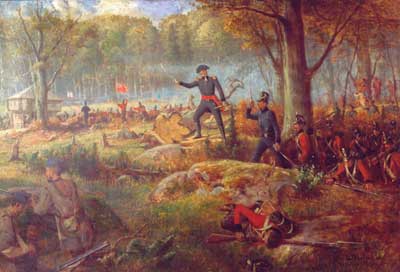
The events in the analyzed story " The Horseman in the Sky" happen in the autumn of the year 1861. That was a year when a Civil War in America began.
Though the story is devided into 4 parts, there we can find only one main setting. The soldier, as a main hero, Carter Druse was laying in a clump of laurel by the side of a road in western Virginia. The author gives a rather volumous description of that place:
"The clump of laurel in which the criminal lay was in the angle of a road which after ascending southward a steep acclivity to that point turned sharply to the west, running along the summit for perhaps one hundred yards. There it turned southward again and went zigzagging downward through the forest. At the salient of that second angle was a large flat rock, jutting out northward, overlooking the deep valley from which the road ascended. The rock capped a high cliff; a stone dropped from its outer edge would have fallen sheer downward one thousand feet to the tops of the pines. The angle where the soldier lay was on another spur of the same cliff. Had he been awake he would have commanded a view, not only of the short arm of the road and the jutting rock, but of the entire profile of the cliff below it. "
So, we know the exact location of the scene, we may imagine the whole picture in the way soldier can see it at that moment.
From the point of view of presentation the story is the 3d person narrative. The setting described in very detailed way indeed. Bierce describes a wonderful nature around that place:
"The country was wooded everywhere except at the bottom of the valley to the northward, where there was a small natural meadow, through which flowed a stream scarcely visible from the valley's rim. This open ground looked hardly larger than an ordinary door-yard, but was really several acres in extent. Its green was more vivid than that of the inclosing forest.."
But then, he stresses on the inervention of the man to this peaceful and beautiful place:
 "No country is so wild and difficult but men will make it a theatre of war; concealed in the forest at the bottom of that military rat-trap, in which half a hundred men in possession of the exits might have starved an army to submission, lay five regiments of Federal infantry" 

After the 1st chapter, the author gives some information about the main character. He tells his father his decision. This also gives us an opportunity to imagine the scene. But then he returns to the present and to the main situational setting.
I came to the conclusion, that the setting of the events is historical. It is presented in the most detailed way. It provides a historical and cultural context that contributes to our understanding of the characters. Somehow it is also symbolizing the emotional state of the character.
Plot peculiarities
Firstly, I would like to point out that the structure of plot is not very typical. (one may not distinguish that type as classic exposition>climax>catastrophe) The greatest conflict's point  set by the author is situated just in the end of the story.  Bierce holds the intrigue. That's why I am not sure, if there is any resolution or denouement in the text, because the plot is rising, and when it gets its higher point - the story quickly ends.
Mentioning all that peculiarities, let's work the plot over in order. The plot of the story runs as follows:

Exposition. Bierce begins with a very detalized description of the main place. He gives the reader a first impressions about the soldier. In the very beginning we don't know yet who is he, or why is he afraid to shoot the enemy and his horse. I'll talk later about his emotions. The author now draws the atmoshere - we can feel that green nature, early autumn, screaming people somewhere . The war is here, every moment is unpredictible.
           Then, comes the second part of the story. The author makes a kind of flashback and here we can get acquainted with the main hero- Carter Druse and understand, why is he participating in this war, just from the dialogue with his father. Actually from this very moment there is the born of an external conflict - two men- a father and the son are now becoming enemies because of the Civil War.
There we return to the present situation. Through his sleepy eyes a soldier saw a figure of a man on the horse. The internal conflict takes place here: the soldier is hasitating whether to shoot the enemy off or not, but a soldier stares at him for a long time. There is given a huge part of characterizing the horseman, then Birce gives the reader the mood, feelings and emotions of the soldier:
"The duty of the soldier was plain: the man must be shot dead from ambush--without warning, without a moment's spiritual preparation, with never so much as an unspoken prayer, he must be sent to his account. But no--there is a hope; he may have discovered nothing--perhaps he is but admiring the sublimity of the landscape. "

Then he gathered up his emotions and remembered his father's words:
"He was calm now. His teeth were firmly but not rigidly closed; his nerves were as tranquil as a sleeping babe's--not a tremor affected any muscle of his body; his breathing, until suspended in the act of taking aim, was regular and slow. Duty had conquered; the spirit had said to the body: "Peace, be still." He fired."
And, expectedly, there shiould be the end. He has done his duty, nothing special has happened, he has was even being ruled by his father's opinion, which was pretty convincing and legal. We can see the third chapter then, the soldier's emotions after the death of his enemy:
 "Filled with amazement and terror by this apparition of a horseman in the sky--half believing himself the chosen scribe of some new Apocalypse, the officer was overcome by the intensity of his emotions; his legs failed him and he fell."
Here comes a kind of resolution. Carter Druse saw a perfect warrior, as the author presents him to the reader. BUT something is hidden in this mesage:
"This officer was a wise man; he knew better than to tell an incredible truth. He said nothing of what he had seen. But when the commander asked him if in his scout he had learned anything of advantage to the expedition he answered:
"Yes, sir; there is no road leading down into this valley from the southward."
This means the author shows what happened when he returned to the camp and talk to the commander. Bierce playes here with time. It is not yet obvious that it happened approximately in half an hour.
However, the strongest moment hasn't come yet. In fourth chapter we are again here, where all started. Carter has a dialogue with a sergeant, and here the truth revealed itself:
"See here, Druse," he said, after a moment's silence, "it's no use making a mystery. I order you to report. Was there anybody on the horse?"
"Yes."
"Well?"
"My father."
The sergeant rose to his feet and walked away. "Good God!" he said."
This part is actually a climax in the story and explains why he shoot the horse, not a rider. A sergeant found out the truth, and the story ends.
Types of speech
We may now talk about some speech types the author used in the text.
the types of speech employed by Ambrose Bierce are rather diverse, they comprise main of them, such as narration, description (descriptions of setting and main heroes) meditation of the main hero, (thus the interior speech and interior monologue), dialogue in the end of the story, between Druse and sergeant. In the second chapter, Druse speaks with his father, there we can see examples of direct speech.
Throughout the text we observe cases of unuttered represented speech - the main hero often thinks, states the questions to himself, hesitates. The given text is a mixture of narration and description with some insertions of direct and represented speech, with philosophical digression and some flashbacks to the past (recollecting father's words).

Tone is serious, sad, ironic, formal.  Tone is achieved through descriptive details of setting and character. Mood refers to the atmosphere of a story there it comes to be mysterious.
Characters
The characters we meet in the story under analysis are only two main protagonists, that make the story vivid and precise. Theese are young soldier -  Carter Druse and a Horseman, his father - a powerful and strong image of warrior. Each of them belongs to seperate parties which have devided american citizens on those who were under Federate party and others which were under Confederate party.
Carter Druse, the hero of the novel is a normal peasant, was born in Virginia. He loved his parents and home, but most of all he loved his country from his deep heart. As a southerner, he decided to join the Union Army of the North. Being for the Army of South, his father had nothing against his son, he respected his choise. Carter Druse is shown as brave, controversial, coward- but above all-patriotic. He isa person, who is able to kill a family member in order to receive peace and victory. He is hesitating, thinking over all the pluses and minuses of the situation. Of course he loved his father, but the love to American peace is closer to him.
The author reveals Carter Druse by means of narrative description with implied judgement. Actually he left the reader to make own judgement- what is better, pushes the reader to put himself on the place of the main hero. From both fact and judgement we derive impression of the main character as strong, responsible and hesitating man who finally makes the powerful decision, which may further change his mind and life. When the author informs us that Carter has killed not his farther, but a horse, which was driven by him,and they both have fallen down the cliff  we come to share his respect and love to his father, for Carter's action and attitude; it was not just a cold case murder. The following comment of the narrator clearly indicates that Carter is full of emotions and dual feelings, but his duty for him is on the first place:
"The man's face was white, but he showed no other sign of emotion. Having answered, he turned away his eyes and said no more".
Details of physical appearance are nearly absent.
Details of character:
"By conscience and courage, by deeds of devotion and daring, he soon commended himself to his fellows and his officers; and it was to these qualities and to some knowledge of the country that he owed his selection for his present perilous duty at the extreme outpost".
Character's actions:
"the officer was overcome by the intensity of his emotions; his legs failed him and he fell."
"The officer rose to his feet, trembling." "Peace, be still. He fired."
Character's speech: "Father, a Union regiment has arrived at Grafton. I am going to join it." (very confidently)
Officer was a wise man; he knew better than to tell an incredible truth. He said nothing of what he had seen. But when the commander asked him if in his scout he had learned anything of advantage to the expedition he answered:
"Yes, sir; there is no road leading down into this valley from the southward."
Character's consiousness: " Is it then so terrible to kill an enemy in war--an enemy who has surprised a secret vital to the safety of one's self and comrades--an enemy more formidable for his knowledge than all his army for its numbers? Carter Druse grew pale; he shook in every limb, turned faint, and saw the statuesque group before him as black figures, rising, falling, moving unsteadily in arcs of circles in a fiery sky. His hand fell away from his weapon, his head slowly dropped until his face rested on the leaves in which he lay. This courageous gentleman and hardy soldier was near swooning from intensity of emotion."

The other character - better to say - problematic image of the story - is a Horseman. As a reader may understand he is the father of Carter. "The father lifted his leonine head, looked at the son a moment in silence, and replied: "Well, go, sir, and whatever may occur do what you conceive to be your duty." "Leonine" - an epithet, which already shows us his grace. But he also asks his son not to bother with this problem his ill mother.
Then we see him in a role of horseman: "was an equestrian statue of impressive dignity. The figure of the man sat the figure of the horse, straight and soldierly, but with the repose of a Grecian god carved in the marble which limits the suggestion of activity." 
We may imagine his dress details: "The gray costume harmonized with its arial background; the metal of accoutrement and caparison was softened and subdued by the shadow"
Then, after Carter fired, there we can observe a ghost image, which can see Carter: "Lifting his eyes to the dizzy altitude of its summit the officer saw an astonishing sight--a man on horseback riding down into the valley through the air! Straight upright sat the rider, in military fashion, with a firm seat in the saddle, a strong clutch upon the rein to hold his charger from too impetuous a plunge."

Personally, I would say thad this is very hard decision. For me it is not a dilemma, I wouldn't kill anyone of my relatives in any case. I think the only reason that justifies Carter is a huge sence of patriotism; he is a man worth admiring and sympathy just for that. The words of the father have strongly set in the head of a soldier, but the power of patriotism sometimes, takes everything. I like how the author shows the characters - Carter is confident and brave, but at the same time hesitative, young and unexperienced soldier, who is going to be an outstanding american warrior. The Father Figure is shown perfectly, the reader can imagine a proud, calm and wise personality. This story is small, but still it gives no free space to continue it, there are no detalized description of main heroes' characters but the atmoshere captures the reader and holds him to the end.

STYLISTIC ANALYSIS
Finally, let's proceed to the last part of our analysis. I shouldn't say that this text is full of expressive means and stylistic devices, because the author's narration in rather serious, the main aim here is to show this ironical effect that one can observe in the end of the novel. That's why he tried not to express the personality of a main hero, no, he was an ordinary man. But through the actions and movements in a climatic moment, we can notice some means of expression, Bierce uses. So, in order to portray the characters, to render the mood and reveal the idea vividly and convincingly, the author of analysed text resorts to such devices:
Lexical:  metaphorstheatre of war, military rat-trap - to express war reality, some territories which are under military actions; equestrian statue - to show the grace and tranquility of a horseman; face of rock - that rock was enormous, even had some kind of face: in the cloud of the horse's mane - the mane was thick, again, author expresses grace of the horse and equestrian; a touch upon a trigger - just one single action.  Personification:  duty had conquered , the spirit had said to the body - to emphasize on the concentration of Carter; a sound that died - when a murdered father fell of the cliff- to show the feeling of a soldier; legs failed him - Carter was frightened; a courtesy that masked a breaking heart - a feeling of father to the son, when he claimed his decision; road turned west, turned southward, went zigzagging - to show the complexity of setting, the territory of the place. Allegory: angel came in a dream; messenger of fate touched - to express the sence of something that hase woke Carter up; some new Apocalypse - after Carter fired, he felt like the whole world is crashing. Periphrasis: the sleeping sentinel, criminal, young Virginian - are the words denoting Carter Druse, in different places and time; equestrian, horseman, figure, statue, a Grecian god in the marble - to emphasize on successfullness of father as the American soldier; officer was overcome by the intensity of his emotions - to express the nervous state of Carter; charger - horse. Different epithets are used:  extended, loosely, perilous in the extreme, quietly but gravely - to create the full characterization of the main hero; brave, compassionate heart - shows power of the opponent; half-defined feeling- which is not yet understandible to Carter; broad awake and keenly alive - to show the aim of Carter; magnified - expresses the astonishment; accoutment softened and subdued by the shadow - to show how perfect the man is, from each side; statue of impressive dignity- impressivness of the figure; with aimless feet - unwillingly; marvelous performance and other - carelessly, fatal, hardly less blue, cautiously - mostly to intensify the meaning of actions and subjects. Simile: as tranquil as a sleeping babe's; as a divine mandate, rang the words; he looked through the deeps of air downward as from the surface to the bottom of translucent sea; hair, waiving like a plume; with all the legs thrown sharply forward as in the act of alighting from a leap - numerous similes in the text help the reader to understand and appreciate the situation in the whole sence. Hyperbole: heroic, almost colossal size - to create the image of something enormous; incredible truth - to exaggerate on the situation, when saying the truth is not necessary; gigantic face of rock - to show how enormous and big the mountain is; in the cloud of horse's lifted mane - thick mane of a horse;
Syntactical: There are some cases of repetitionwithout the movement, without the sound..; to look into his face, into his eyes..; without warning, without a momen'ts preparation, with never so much as unspoken prayer - to point out, put a stress on the details of situation; and climax: to look into his face, into his eyes, into his brave, compassionate heart - to show the sequence of the actions; Druse grew pale, shook in very limb, turned faint - express the sequence of feelings; anticlimax - without a movement, without a sound, in the profound silence - shows how silen he became.
There are no phonetic, graphic and phonetic, graphic means of expression.

Summing up the analysis of the given extract, one should say that the writer Ambrose Bierce brilliantly uses mostly lexical devices, such as metaphor, epithet, simile, hyperbole, periphrasis, and syntactically, climax, anticlimax and repetition, which help to reveal the main character's nature, to create true-to-life atmosphere of the events and played a considerable role in this sad but simultaneously interesting and breathtaking story.

вторник, 7 января 2014 г.

#7 Expressive means and Stylistic devices

Finally, let's proceed to the last part of our analysis. I shouldn't say that this text is full of expressive means and stylistic devices, because the author's narration in rather serious, the main aim here is to show this ironical effect that one can observe in the end of the novel. That's why he tried not to express the personality of a main hero, no, he was an ordinary man. But through the actions and movements in a climatic moment, we can notice some means of expression, Bierce uses. So, in order to portray the characters, to render the mood and reveal the idea vividly and convincingly, the author of analysed text resorts to such devices:
Lexical:  metaphors: theatre of war, military rat-trap - to express war reality, some territories which are under military actions; equestrian statue - to show the grace and tranquility of a horseman; face of rock - that rock was enormous, even had some kind of face: in the cloud of the horse's mane - the mane was thick, again, author expresses grace of the horse and equestrian; a touch upon a trigger - just one single action.  Personification:  duty had conquered , the spirit had said to the body - to emphasize on the concentration of Carter; a sound that died - when a murdered father fell of the cliff- to show the feeling of a soldier; legs failed him - Carter was frightened; a courtesy that masked a breaking heart - a feeling of father to the son, when he claimed his decision; road turned west, turned southward, went zigzagging - to show the complexity of setting, the territory of the place. Allegory: angel came in a dream; messenger of fate touched - to express the sence of something that hase woke Carter up; some new Apocalypse - after Carter fired, he felt like the whole world is crashing. Periphrasis: the sleeping sentinel, criminal, young Virginian - are the words denoting Carter Druse, in different places and time; equestrian, horseman, figure, statue, a Grecian god in the marble - to emphasize on successfullness of father as the American soldier; officer was overcome by the intensity of his emotions - to express the nervous state of Carter; charger - horse. Different epithets are used:  extended, loosely, perilous in the extreme, quietly but gravely - to create the full characterization of the main hero; brave, compassionate heart - shows power of the opponent; half-defined feeling- which is not yet understandible to Carter; broad awake and keenly alive - to show the aim of Carter; magnified - expresses the astonishment; accoutment softened and subdued by the shadow - to show how perfect the man is, from each side; statue of impressive dignity- impressivness of the figure; with aimless feet - unwillingly; marvelous performance and other - carelessly, fatal, hardly less blue, cautiously - mostly to intensify the meaning of actions and subjects. Simile: as tranquil as a sleeping babe's; as a divine mandate, rang the words; he looked through the deeps of air downward as from the surface to the bottom of translucent sea; hair, waiving like a plume; with all the legs thrown sharply forward as in the act of alighting from a leap - numerous similes in the text help the reader to understand and appreciate the situation in the whole sence. Hyperbole: heroic, almost colossal size - to create the image of something enormous; incredible truth - to exaggerate on the situation, when saying the truth is not necessary; gigantic face of rock - to show how enormous and big the mountain is; in the cloud of horse's lifted mane - thick mane of a horse;
Syntactical: There are some cases of repetition: without the movement, without the sound..; to look into his face, into his eyes..; without warning, without a momen'ts preparation, with never so much as unspoken prayer - to point out, put a stress on the details of situation; and climax: to look into his face, into his eyes, into his brave, compassionate heart - to show the sequence of the actions; Druse grew pale, shook in very limb, turned faint - express the sequence of feelings; anticlimax - without a movement, without a sound, in the profound silence - shows how silen he became.
There are no phonetic, graphic and phonetic, graphic means of expression.
Summing up the analysis of the given extract, one should say that the writer Ambrose Bierce brilliantly uses mostly lexical devices, such as metaphor, epithet, simile, hyperbole, periphrasis, and syntactically, climax, anticlimax and repetition, which help to reveal the main character's nature, to create true-to-life atmosphere of the events and played a considerable role in this sad but simultaneously interesting and breathtaking story.
#6 Characters

" Whatever may occur, do what you conceive to be your duty. "

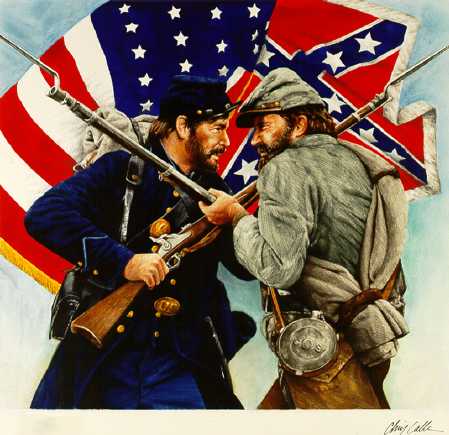
The characters we meet in the story under analysis are only two main protagonists, that make the story vivid and precise. Theese are young soldier -  Carter Druse and a Horseman, his father - a powerful and strong image of warrior. Each of them belongs to seperate parties which have devided american citizens on those who were under Federate party and others which were under Confederate party.
Carter Druse, the hero of the novel is a normal peasant, was born in Virginia. He loved his parents and home, but most of all he loved his country from his deep heart. As a southerner, he decided to join the Union Army of the North. Being for the Army of South, his father had nothing against his son, he respected his choise. Carter Druse is shown as brave, controversial, coward- but above all-patriotic. He isa person, who is able to kill a family member in order to receive peace and victory. He is hesitating, thinking over all the pluses and minuses of the situation. Of course he loved his father, but the love to American peace is closer to him.
The author reveals Carter Druse by means of narrative description with implied judgement. Actually he left the reader to make own judgement- what is better, pushes the reader to put himself on the place of the main hero. From both fact and judgement we derive impression of the main character as strong, responsible and hesitating man who finally makes the powerful decision, which may further change his mind and life. When the author informs us that Carter has killed not his farther, but a horse, which was driven by him,and they both have fallen down the cliff  we come to share his respect and love to his father, for Carter's action and attitude; it was not just a cold case murder. The following comment of the narrator clearly indicates that Carter is full of emotions and dual feelings, but his duty for him is on the first place:
"The man's face was white, but he showed no other sign of emotion. Having answered, he turned away his eyes and said no more".
Details of physical appearance are nearly absent.
Details of character:
"By conscience and courage, by deeds of devotion and daring, he soon commended himself to his fellows and his officers; and it was to these qualities and to some knowledge of the country that he owed his selection for his present perilous duty at the extreme outpost".
Character's actions:
"the officer was overcome by the intensity of his emotions; his legs failed him and he fell."
"The officer rose to his feet, trembling." "Peace, be still. He fired."
Character's speech: "Father, a Union regiment has arrived at Grafton. I am going to join it." (very confidently)
Officer was a wise man; he knew better than to tell an incredible truth. He said nothing of what he had seen. But when the commander asked him if in his scout he had learned anything of advantage to the expedition he answered: /
"Yes, sir; there is no road leading down into this valley from the southward."
Character's consiousness: " Is it then so terrible to kill an enemy in war--an enemy who has surprised a secret vital to the safety of one's self and comrades--an enemy more formidable for his knowledge than all his army for its numbers? Carter Druse grew pale; he shook in every limb, turned faint, and saw the statuesque group before him as black figures, rising, falling, moving unsteadily in arcs of circles in a fiery sky. His hand fell away from his weapon, his head slowly dropped until his face rested on the leaves in which he lay. This courageous gentleman and hardy soldier was near swooning from intensity of emotion."

The other character - better to say - problematic image of the story - is a Horseman. As a reader may understand he is the father of Carter. "The father lifted his leonine head, looked at the son a moment in silence, and replied: "Well, go, sir, and whatever may occur do what you conceive to be your duty." "Leonine" - an epithet, which already shows us his grace. But he also asks his son not to bother with this problem his ill mother.
Then we see him in a role of horseman: "was an equestrian statue of impressive dignity. The figure of the man sat the figure of the horse, straight and soldierly, but with the repose of a Grecian god carved in the marble which limits the suggestion of activity." 
We may imagine his dress details: "The gray costume harmonized with its arial background; the metal of accoutrement and caparison was softened and subdued by the shadow"
Then, after Carter fired, there we can observe a ghost image, which can see Carter: "Lifting his eyes to the dizzy altitude of its summit the officer saw an astonishing sight--a man on horseback riding down into the valley through the air! Straight upright sat the rider, in military fashion, with a firm seat in the saddle, a strong clutch upon the rein to hold his charger from too impetuous a plunge."

Personally, I would say thad this is very hard decision. For me it is not a dilemma, I wouldn't kill anyone of my relatives in any case. I think the only reason that justifies Carter is a huge sence of patriotism; he is a man worth admiring and sympathy just for that. The words of the father have strongly set in the head of a soldier, but the power of patriotism sometimes, takes everything. I like how the author shows the characters - Carter is confident and brave, but at the same time hesitative, young and unexperienced soldier, who is going to be an outstanding american warrior. The Father Figure is shown perfectly, the reader can imagine a proud, calm and wise personality. This story is small, but still it gives no free space to continue it, there are no detalized description of main heroes' characters but the atmoshere captures the reader and holds him to the end.

#5(2) Speech types

Having read the story for the fifth time, we have already distinguished some peculiar features of the plot. According to our conclusion, we may now talk about some speech types the author used in the text.
the types of speech employed by Ambrose Bierce are rather diverse, they comprise main of them, such as narration, description (descriptions of setting and main heroes) meditation of the main hero, (thus the interior speech and interior monologue), dialogue in the end of the story, between Druse and sergeant. In the second chapter, Druse speaks with his father, there we can see examples of direct speech. 
Throughout the text we observe cases of unuttered represented speech - the main hero often thinks, states the questions to himself, hesitates. The given text is a mixture of narration and description with some insertions of direct and represented speech, with philosophical digression and some flashbacks to the past (recollecting father's words).
Tone is serious, sad, ironic, formal.  Tone is achieved through descriptive details of setting and character. Mood refers to the atmosphere of a story there it comes to be mysterious. 

воскресенье, 1 декабря 2013 г.

#5(1) The Plot Peculiarities

Having read the story for the fifth time, I understood, that it's time to think the plot over.

Firstly, I would like to point out that the structure of plot is not very typical. (one may not distinguish that type as classic exposition>climax>catastrophe) The greatest conflict's point  set by the author is situated just in the end of the story. Suprising ending, are you agree? Bierce holds the intrigue. That's why I am not sure, if there is any resolution or denouement in the text, because the plot is rising, and when it gets its higher point - the story quickly ends.
Mentioning all that peculiarities, let's work the plot over in order. The plot of the story runs as follows:

Exposition. Bierce begins with a very detalized description of the main place. He gives the reader a first impressions about the soldier. In the very beginning we don't know yet who is he, or why is he afraid to shoot the enemy and his horse. I'll talk later about his emotions. The author now draws the atmoshere - we can feel that green nature, early autumn, screaming people somewhere . The war is here, every moment is unpredictible. 
           Then, comes the second part of the story. The author makes a kind of flashback and here we can get acquainted with the main hero- Carter Druse and understand, why is he participating in this war, just from the dialogue with his father. Actually from this very moment there is the born of an external conflict - two men- a father and the son are now becoming enemies because of the Civil War. 
There we return to the present situation. Through his sleepy eyes a soldier saw a figure of a man on the horse. The internal conflict takes place here: the soldier is hasitating whether to shoot the enemy off or not, but a soldier stares at him for a long time. There is given a huge part of characterizing the horseman, then Birce gives the reader the mood, feelings and emotions of the soldier:
"The duty of the soldier was plain: the man must be shot dead from ambush--without warning, without a moment's spiritual preparation, with never so much as an unspoken prayer, he must be sent to his account. But no--there is a hope; he may have discovered nothing--perhaps he is but admiring the sublimity of the landscape. "

Then he gathered up his emotions and remembered his father's words:
"He was calm now. His teeth were firmly but not rigidly closed; his nerves were as tranquil as a sleeping babe's--not a tremor affected any muscle of his body; his breathing, until suspended in the act of taking aim, was regular and slow. Duty had conquered; the spirit had said to the body: "Peace, be still." He fired."
And, expectedly, there shiould be the end. He has done his duty, nothing special has happened, he has was even being ruled by his father's opinion, which was pretty convincing and legal. We can see the third chapter then, the soldier's emotions after the death of his enemy:
 "Filled with amazement and terror by this apparition of a horseman in the sky--half believing himself the chosen scribe of some new Apocalypse, the officer was overcome by the intensity of his emotions; his legs failed him and he fell."
Here comes a kind of resolution. Carter Druse saw a perfect warrior, as the author presents him to the reader. BUT something is hidden in this mesage:
"This officer was a wise man; he knew better than to tell an incredible truth. He said nothing of what he had seen. But when the commander asked him if in his scout he had learned anything of advantage to the expedition he answered:
"Yes, sir; there is no road leading down into this valley from the southward."
This means the author shows what happened when he returned to the camp and talk to the commander. Bierce playes here with time. It is not yet obvious that it happened approximately in half an hour.
However, the strongest moment hasn't come yet. In fourth chapter we are again here, where all started. Carter has a dialogue with a sergeant, and here the truth revealed itself:
"See here, Druse," he said, after a moment's silence, "it's no use making a mystery. I order you to report. Was there anybody on the horse?"
"Yes."
"Well?"
"My father."
The sergeant rose to his feet and walked away. "Good God!" he said." 
This part is actually a climax in the story and explains why he shoot the horse, not a rider. A sergeant found out the truth, and the story ends..
That was my vision of the plot. Next time I'll write about types of speech.

суббота, 30 ноября 2013 г.

#4 The setting of a story

The events in the analyzed story " The Horseman in the Sky" happen in the autumn of the year 1861. That was a year when a Civil War in America began. 
Though the story is devided into 4 parts, there we can find only one main setting. The soldier, as a main hero, Carter Druse was laying in a clump of laurel by the side of a road in western Virginia. The author gives a rather volumous description of that place:
"The clump of laurel in which the criminal lay was in the angle of a road which after ascending southward a steep acclivity to that point turned sharply to the west, running along the summit for perhaps one hundred yards. There it turned southward again and went zigzagging downward through the forest. At the salient of that second angle was a large flat rock, jutting out northward, overlooking the deep valley from which the road ascended. The rock capped a high cliff; a stone dropped from its outer edge would have fallen sheer downward one thousand feet to the tops of the pines. The angle where the soldier lay was on another spur of the same cliff. Had he been awake he would have commanded a view, not only of the short arm of the road and the jutting rock, but of the entire profile of the cliff below it. "
So, we know the exact location of the scene, we may imagine the whole picture in the way soldier can see it at that moment.
Oops, I've almost forgot to mention that from the point of view of presentation the story is the 3d person narrative. You know, a reader will 100% say that the author has also participated in the war. The setting described in very detailed way indeed.
Bierce describes a wonderful nature around that place:
"The country was wooded everywhere except at the bottom of the valley to the northward, where there was a small natural meadow, through which flowed a stream scarcely visible from the valley's rim. This open ground looked hardly larger than an ordinary door-yard, but was really several acres in extent. Its green was more vivid than that of the inclosing forest.."
But then, he stresses on the inervention of the man to this peaceful and beautiful place:

 "No country is so wild and difficult but men will make it a theatre of war; concealed in the forest at the bottom of that military rat-trap, in which half a hundred men in possession of the exits might have starved an army to submission, lay five regiments of Federal infantry" 

After the 1st chapter, the author gives some information about the main character. He tells his father his decision. This also gives us an opportunity to imagine the scene. But then he returns to the present and to the main situational setting.

So, after analysing some plot details I came to the conclusion, that the setting of the events is historical. It is presented in the most detailed way. It provides a historical and cultural context that contributes to our understanding of the characters. Somehow it is also symbolizing the emotional state of the character.

#3 Author: Life, literary style, publications.

Now, let me introduce the author of my chosen novel. This page comprises information about his individual style, cultural and histotical background and other famous works.         

Ambrose Bierce

1842–1914
Ambrose Bierce
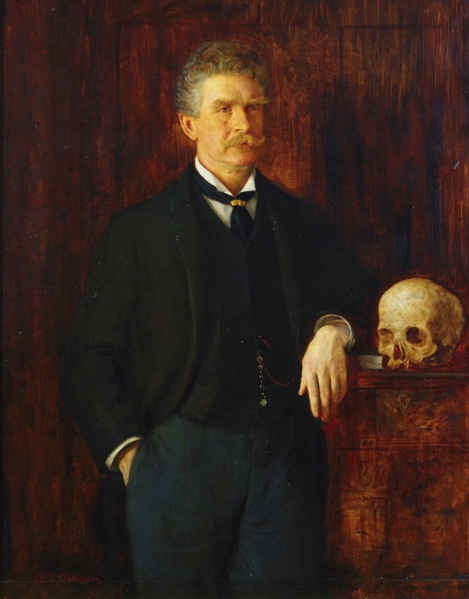
Ambrose Bierce's literary reputation is based primarily on his short stories about the Civil War and the supernatural. He was also a journalist, poet, essayist and critic. Often compared to the tales of Edgar Allan Poe, these stories share an attraction to death in its more bizarre forms, featuring depictions of mental deterioration, uncanny, otherworldly manifestations, and expressions of the horror of existence in a meaningless universe.  Critics find him intent on conveying his misanthropy and pessimism. In his lifetime Bierce was famous as a California journalist dedicated to exposing the truth as he understood it. For his sardonic wit and damning observations on the personalities and events of the day, he became known as "the wickedest man in San Francisco, Bitter Bierce".
SOME FACTS ABOUT HIS LIFE AND LITERARY CAREER 

  • He was born in Meigs County, Ohio. His parents were farmers and he was the tenth of thirteen children, all of whom were given names beginning with "A" at their father's insistence. The family moved to Indiana, where Bierce went to high school; he later attended the Kentucky Military Institute. At the outbreak of the Civil War, he enlisted in the Union army. After the war Bierce traveled with a military expedition to San Francisco, where he left the army and prepared himself for a literary career.  

  •  In 1868 he became the editor of The News Letter, for which he wrote his famous "Town Crier" column. He wrote for Fun and Figaro magazines and created essays, epigrams, and short stories. 


  • Bierce's major fiction was collected in Tales of Soldiers and Civilians (1891) and Can Such Things Be? (1893). As in my story I have chosen, any of these stories are realistic depictions of the author's experiences in the Civil War. Other stories were "Chickamauga,"  "An Occurrence at Owl Creek Bridge," "The Death of Halpin Frayser." Bierce uses  black humor, particularly in the ironic and hideous deaths his protagonists often suffer. 


  • Bierce's most acclaimed work is The Devil's Dictionary(1906), a lexicon of its author's wit where Bierce vented much of his contempt for politics, religion, society, and conventional human values. (http://www.thedevilsdictionary.com/ - I strongly recommend you to read it, so many things here you'll find true and real).


  • In 1914 he informed some of his correspondents that he intended to enter Mexico  as an observer during that country's civil war. He was never heard from again, and the circumstances of his death are uncertain.